Where to Swim in Greece in July: Warm Beaches & Tips
July in Greece? You’ve picked the absolute peak of swimming season. The Mediterranean is gloriously warm, the sun shines for about 14 hours a day, and every beach, from tiny hidden coves to famous stretches of sand, is calling your name. If you’re dreaming of crystal-clear turquoise water warm enough to stay in for hours, Greece in July delivers in spades.
But here’s the thing – Greece has thousands of islands and endless coastline, and not every beach is equal in July. Some spots have bathtub-warm water and mirror-calm conditions, while others get hit with strong winds that create waves. Let me break down exactly where you should swim, what to expect, and how to make the most of Greece’s summer beach paradise.
Why July Is Swimming Heaven in Greece
Sea temperatures across Greece in July average around 75-79°F (24-26°C) – warm enough for extended swimming without wetsuits. Some spots like Rhodes hit 79°F (26°C), Crete reaches 78°F (25-26°C), and Zakynthos warms to 77-82°F (25.6-28.5°C).
The weather is stunning – minimal rainfall (basically zero), air temperatures around 79-86°F (26-30°C), and 340 hours of sunshine in July. It’s hot, dry, and perfect for beach life.
But July brings one challenge: the Meltemi winds. These strong, dry northerly winds blow across the Aegean Sea, especially in the Cyclades. They’re most intense in July and August, sometimes reaching Force 7. They keep temperatures from getting unbearable, but they create choppy seas on north-facing beaches. Don’t worry – there are strategies to avoid rough water.
Peak season means crowds. July is when European summer holidays kick in, so popular beaches get packed. Book accommodation early and have backup beach plans.
Warmest Sea Waters in Greece in July
Crete (South & East Coast)
Crete consistently offers some of Greece’s warmest swimming, especially on the south coast facing the Libyan Sea. Water temperatures average 78°F (26°C), feeling “very warm” and “bath-like” according to travelers.
Top beaches: Elafonissi (pink sand, shallow lagoon-like water), Falassarna (long sandy beach with turquoise water), Matala (famous hippie beach with caves), and Vai (exotic palm forest beach on the east coast). The south coast is generally calmer than the north because it’s sheltered from Meltemi winds.
Why Crete is warmer: It’s the southernmost major Greek island, catching more intense sun. The south-facing Libyan Sea has less wind exposure than the Aegean.
Dodecanese Islands
Rhodes, Kos, Karpathos, and Symi offer warm, sheltered swimming perfect for families. Rhodes hits 79°F (26°C) average in July, with some days reaching 81-82°F. Karpathos is actually the hottest destination in Greece with monthly averages around 86°F (30°C).
The east coasts of these islands tend to be calmer because they’re sheltered from westerly winds. Lindos in Rhodes is rated “ideal swimming” with water temperatures of 79°F (26°C). Kos maintains pleasant swimming temperatures around 76-79°F.
These islands get 13 hours of sunshine daily in summer, guaranteeing great beach days. The combination of warm water and calm conditions makes the Dodecanese perfect for relaxed swimmers and families with kids.
Ionian Islands
Zakynthos, Kefalonia, Lefkada, and Corfu face west into the Ionian Sea, which often feels warmer and calmer than the Aegean. Zakynthos water averages 77°F (25.6°C) in July, with peaks around 82°F (28.5°C). Corfu and the other Ionian islands are rated “pleasant swimming” throughout July.
Why the Ionian feels warmer: Less affected by Meltemi winds, more sheltered bays, and the sea temperature in July and August reaches 77°F (25°C) – ideal for swimming and snorkeling.
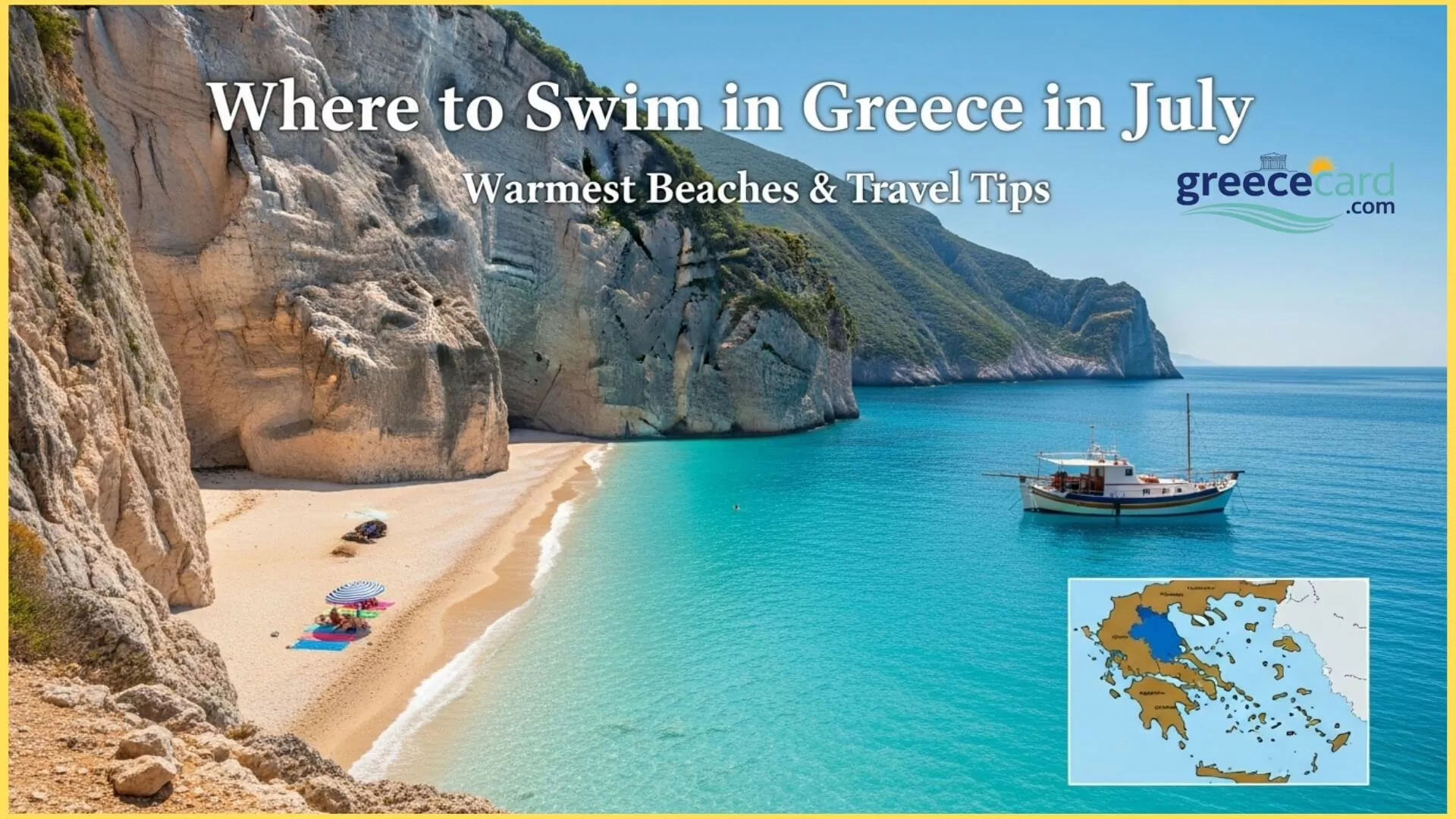
Best beaches: Navagio (Shipwreck Beach) in Zakynthos (accessible by boat), Myrtos Beach in Kefalonia (dramatic cliffs and turquoise water), Porto Katsiki in Lefkada (stunning white cliffs), and Glyfada in Corfu (Blue Flag beach with facilities).
The Ionian islands have gorgeous, long sandy beaches perfect for extended swimming sessions, and the water visibility is excellent for snorkeling.
Cyclades (Strategic Beach Selection)
The Cyclades (Mykonos, Santorini, Paros, Naxos, Milos) are stunning but require smart beach choices in July. The Meltemi winds hit these islands hardest.
Paros and Naxos offer the best balance – warm water around 78°F (26°C) with beaches facing different directions, so you can choose sheltered spots based on daily wind conditions. South-facing beaches are your friend here – they avoid the worst of the northerly winds.
Milos has incredible hidden coves and calm swimming spots. Santorini hits 78°F (26°C), but the beaches have volcanic black/red sand that gets scorching hot – bring beach shoes.
Pro tip: Check wind forecasts daily and pick beaches on the leeward (sheltered) side of islands. Early morning, before winds pick up (usually strengthening after 11 AM), offers the calmest conditions.
Best Beaches for Swimming in July
Best Sandy Beaches with Shallow Entry
Elafonissi (Crete) – pink sand, lagoon-like shallow water, family paradise
Vai (Crete) – exotic palm forest setting, gentle slope
Naxos beaches (Agios Prokopios, Plaka) – kilometers of sand, gradual depth
Golden Beach (Paros) – Blue Flag, long sandy stretch
Playa de Palma style beaches across the east coast
Shallow entry beaches are perfect for kids, elderly swimmers, and anyone who wants to wade out gradually.
Best for Calm, Sheltered Water
Lindos (Rhodes) – bay protected by hills, rated “ideal swimming.”
Vlichada (Santorini) – sheltered by volcanic cliffs
Symi harbor beaches – tiny protected coves in the Dodecanese
South-facing Crete beaches – Libyan Sea calm
Zakynthos west coast coves – sheltered from Meltemi
Look for beaches in bays with surrounding hills or headlands that blockthe ind. Local tavernas can tell you which beaches are calmest on any given day.
Best for Snorkeling and Clear Water
Kathisma (Lefkada) – Blue Flag, crystal visibility
Skala Eressos (Lesbos) – Blue Flag, clear waters
Kamares (Sifnos) – Blue Flag, clean and clear
Possidi Beach (mainland northern Greece) – Blue Flag certified
Any small rocky cove in the Dodecanese – less sediment means clearer water
Rocky beaches typically have better visibility than sandy ones because there’s less sand stirred up by waves. Bring your own snorkel gear for the best experience.
Where to Avoid Rough Seas in July
North-facing beaches in the Cyclades get hammered by Meltemi winds in July. The Mykonos north coast, northern Paros, and northern Naxos can have choppy, difficult swimming conditions when winds are strong.
The Meltemi blows from late May to mid-September, peaking in July and August. It typically lasts 3-6 days at a time. When it’s blowing strongly, head to south-facing beaches or the Ionian islands, which are less affected.
Check daily wind forecasts: Websites like Windy.com or Windguru.com show wind speed and direction. Anything above 20-25 knots makes swimming less pleasant. Early mornings (before 10 AM) are typically calmest before winds strengthen.
Weakening Meltemi = heat waves: Interestingly, when the Meltemi weakens, Greece can experience intense heat waves because the cooling wind effect disappears. So sometimes choppy seas are the price for bearable temperatures!
Practical Swimming Tips for Greece in July
What to Pack
Reef shoes/water shoes: Greek beaches range from smooth sand to pebbles to rocky volcanic shores. Water shoes make life way easier and protect against sea urchins.
High SPF sunscreen: Greek summer sun is intense. SPF 50+ minimum, reef-safe if possible. Reapply every 2 hours.
UV protection shirt: Long-sleeve rash guards prevent shoulder/back burns during extended swimming.
Snorkel gear: Rental quality varies. Bringing your own ensures a good fit and hygiene.
Beach umbrella vs organized beaches: Many Greek beaches have organized sections with paid umbrellas and loungers (€8-15/day). Remote beaches require your own shade. Inthe July heat, shade is essential.
Best Times to Swim
Early morning (7-10 AM): Calmest water before Meltemi picks up, fewer crowds, cooler air temps. Best time for serious swimming.
Late afternoon (5-7 PM): Water is warmest after a day of sun, winds often decrease slightly, and crowds thin as people head to dinner. Magic hour lighting for photos.
Avoid midday (12-3 PM): Hottest air temps, strongest UV, most crowded, and potentially windiest. Unless you love baking, skip this window or seek shaded coves.
Safety Tips
UV protection: Greece in July has a high to very high UV index. Limit sun exposure between 10 AM and 4 PM. Sunglasses, hats, and frequent sunscreen application are non-negotiable.
Jellyfish: Occasional but not common in July. If you see them, alert beach staff. Most are harmless but can sting. Vinegar helps with stings.
Sea urchins: Common on rocky bottoms and around pier structures. Reef shoes help. If stepped on, seek medical help to remove spines properly.
Blue Flag beaches: Greece has numerous Blue Flag certified beaches meeting high standards for water quality, safety, facilities, and environmental management. These always have lifeguards during peak season and good infrastructure.
Heat awareness: Air temperatures can exceed 90°F (32°C). Drink tons of water, seek shade regularly, and watch for heat exhaustion signs (dizziness, nausea, excessive fatigue).
Avoiding July Beach Crowds
Early arrival: Hit popular beaches by 9 AM to claim good spots. By 11 AM, prime real estate is gone.
Lesser-known alternatives: Every famous beach has lesser-known neighbors. Ask locals for recommendations. Islands like Symi, Karpathos, and Milos have incredible beaches with fewer tourists than Mykonos or Santorini.
Boat trips: Day cruises take you to hidden coves unreachable by road. Often includes swimming stops at multiple secluded spots.
Midweek visits: Weekends see Greeks on beach trips. Tuesday-Thursday are slightly less crowded.
Best Destinations by Traveler Type
Best for families: The Dodecanese (especially Rhodes and Kos) offer warm, calm water, shallow beaches, organized facilities, and child-friendly resorts.
Best for couples: Santorini and Milos combine romantic settings with beautiful swimming. Zakynthos and Kefalonia in the Ionians offer stunning natural beauty.
Best for solo travelers: Crete gives you variety – beaches, hiking, history, nightlife. Easy to meet people, affordable, and diverse enough to never get bored.
Best for luxury: Mykonos and certain parts of Crete (Elounda, Agios Nikolaos) offer upscale beach clubs, yacht culture, and premium amenities.
FAQs
Is the sea warm enough to swim in Greece in July?
Absolutely. Sea temperatures range from 75-79°F (24-26°C) across most of Greece, with some spots like Rhodes and parts of Crete hitting 79-82°F (26-28°C). This is considered “pleasant” to “ideal” swimming – warm enough for hours in the water without wetsuits.
Where is the warmest water in Greece in July?
Crete’s south coast (Libyan Sea side), Rhodes and the Dodecanese islands, and Zakynthos consistently have the warmest water, averaging 77-79°F (25-26°C). Karpathos is the hottest destination overall.
Is Greece too crowded in July?
July is peak season, so yes, popular destinations (Santorini, Mykonos, famous beaches) get very crowded. However, Greece has so many islands and beaches that you can easily find less-touristy alternatives. Book accommodation early, arrive at beaches early in the morning, and consider lesser-known islands like Symi, Karpathos, Milos, or Naxos.
Can you swim comfortably without a wetsuit?
100% yes. Water temperatures of 75-79°F (24-26°C) are perfect for extended swimming in just a bathing suit. Wetsuits are completely unnecessary in Greece in July – in fact, you might wish the water were cooler on the hottest days!
Your Greek Swimming Adventure Awaits
For the warmest, calmest water, head to Crete’s south coast, the Dodecanese islands (Rhodes, Kos, Karpathos), or the Ionian islands (Zakynthos, Kefalonia). These regions offer 77-79°F (25-26°C) water with sheltered swimming conditions perfect for families and relaxed swimmers.
If you’re island-hopping in the Cyclades, be strategic – choose south-facing beaches when Meltemi winds are strong, swim early morning for the calmest conditions, and don’t fight the wind; work with it by picking the right beach for the day.
Book early for July travel – it’s Greece’s busiest month and the best hotels and locations fill up fast. Pack excellent sun protection, water shoes, and your own snorkel gear. Most importantly, prepare for some of the most beautiful swimming you’ll ever experience – warm Mediterranean water, stunning scenery, and that distinctly Greek combination of ancient history and modern beach culture.